
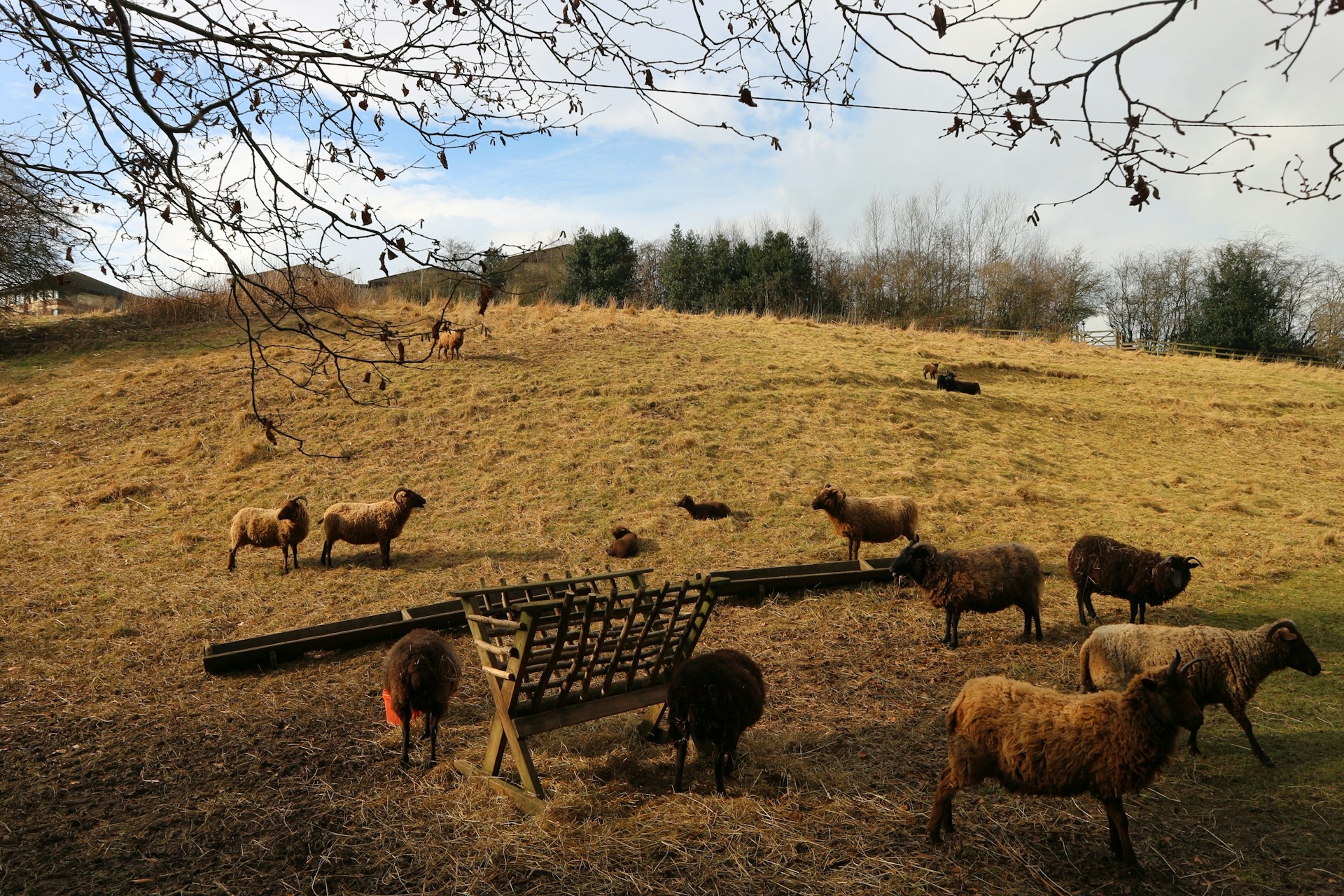
Part of the joy of having lots of godchildren has been getting to know them as they grow. But I’ve been particularly enjoying getting to know the older ones as they head through their teens into adulthood.
It’s fun becoming friends with them, in their own right, independent of their parents – and, not long ago, I was having a chat with one of my godsons about sheep!
Having grown up in a farming family, as part of a farming community, he’s known from an early age that he wants to be a sheep farmer. He’s a natural shepherd, who seems to come alive during lambing season, and I love chatting with him about all-things-sheep whenever I get the chance.
Thinking about shepherds and sheep feels appropriate at this time of the year.
We’re only a few days away from Advent, when many of us will begin to reflect on the Christmas story and its incredible cast of characters.
Jesus, of course, has the starring role.
But what about the shepherds and their flocks of sheep? Have you ever considered why God chose them to play a part in the story?
***
My question
As I’ve been getting ready for Advent, I’ve been re-reading Luke 2: 1-20, and I’ve noticed something new. It’s only something small, but I’ve noticed it nonetheless, and it’s got me asking questions …
In Luke 2: 12, the angel says to the shepherds: “ … This will be a sign to you: You will find a baby wrapped in cloths and lying in a manger.” But then, in Luke 2: 16, we are told that the shepherds “hurried off and found Mary and Joseph, and the baby, who was lying in the manger.”
What I hadn’t noticed before was this change from “a” to “the“, and I found myself asking why: Why does the article change? Why do the angelic instructions speak about “a manger”, only for the shepherds to go to “the manger”?
More importantly, how did the shepherds know which manger the angel was talking about, and why does this matter?
***
The people
In ancient Israel, being a shepherd was a lowly occupation. Looking after sheep was viewed as an insignificant and unimportant role.
(Just think about David, as a young lad, by way of example. His father Jesse almost forgot to introduce him to Samuel, in 1 Samuel 16: 11, because he was simply “tending sheep“.)
The only exception seems to be the shepherds from the tribe of Levi.
Unlike the other tribes of Israel, the members of the tribe of Levi were set apart for religious roles – performing priestly duties, teaching the Torah and serving the community – initially in the tabernacle and later in the temple. (See Deuteronomy 10: 8-9)
Unlike the other tribes, the Levites were not allocated any territory within the Promised Land. Instead, they were given specific cities and pastures for their livestock (including their sheep) that were scattered throughout the territory allocated to all the other tribes. (See Numbers 35: 1-8.)
This means the Levite shepherds were, like the rest of their tribe, set apart for a specific role.
It’s believed that part of this specific role included caring for the flocks of sheep that were destined to give birth to the lambs that would be sacrificed in the temple – and that they did this from a dedicated place, just outside Bethlehem, about four miles from Jerusalem.
***
The place
The location of this dedicated place lies to the north east of Bethlehem and it’s mentioned first in Genesis 35: 19-21, just after Jacob’s beloved wife Rachel dies, while giving birth to Benjamin:
“So Rachel died and was buried on the way to Ephrath, that is, Bethlehem. Over her tomb Jacob set up a pillar, and to this day that pillar marks Rachel’s tomb. Israel moved on again and pitched his tent beyond Migdal Eder.”
When Jacob (who God had renamed ‘Israel’) “moved on again” after burying Rachel, he “pitched his tent beyond Migdal Eder”.
He would have done this with his family, his flocks and his entire entourage – and it meant, from then on, that Migdal Eder became a place of significance.
The name ‘Migdal Eder’ translates as ‘watchtower of the flock’.
In Migdal Eder, there was, quite literally, a tower from which the shepherds could look out and watch over their flocks of sheep.
***
The purpose
During the reign of King David, the tower at Migdal Eder was used as a stronghold.
By the time of Jesus’ birth, the tower was being used by shepherds. Tradition has it that this was where the sacrificial lambs were birthed, complying with the highest possible standards of ceremonial cleanliness, in order to meet the rigorous requirements of the Jewish laws at that time.
This mattered because Numbers 28: 3-4 required a daily sacrifice of two male lambs, without spot, blemish or defect, as an offering for sin, one in the morning, the other in the evening.
So each time a male lamb was born in Migdal Eder, the shepherds would inspect it to see if it was free from spot, blemish or defect.
Each male lamb that passed this test would be wrapped in swaddling cloths, to protect it from injury. Then it would be placed in the manger, there at Migdal Eder, before being further inspected.
For the lambs that passed this additional inspection, they would be selected for sacrifice, and then taken to the temple in Jerusalem, which was walking distance from Migdal Eder.
***
The prophecIES
Meanwhile, over in Matthew 2: 1-8, in a different part of the Christmas story, we are told of a conversation between King Herod and the Magi.
During this conversation, Herod asks the Magi where the King of the Jews is to be born. In response, the Magi say that they believe he will be born in Bethlehem in Judea, and they back this up by quoting Micah 5: 2: “But you, Bethlehem, in the land of Judah, are by no means least among the rulers of Judah; for out of you will come a ruler who will shepherd my people Israel.” (Matthew 2: 6)
This tells us that, prophetically speaking, God’s plan was always for Jesus to be born in Bethlehem, something that many of us are aware.
But there’s also another prophecy in Micah, which goes a step further: “As for you, watchtower of the flock, stronghold of Daughter Zion, the former dominion will be restored to you; kingship will come to Daughter Jerusalem.” (Micah 4: 8)
Could this be God, prophetically speaking, indicating that the King of the Jews would come to the “watchtower of the flock”, Migdal Eder?
Could it be that this precise place was where God had planned, all along, for Jesus to be born?
We can’t be sure, but it’s definitely a possibility!
***
The premise
As I’ve been digging into these things, I’ve found myself pondering …
Was it that those particular shepherds, on that particular night, were in the fields not far from Migdal Eder?
Did they understand, immediately and instinctively, that the angel was speaking about the only manger where sacrificial lambs were birthed, at the watchtower at Migdal Eder?
Is this why they knew exactly where to go, without the angel giving them precise instructions?
Did they then go to Migdal Eder, find the baby, and “inspect” him, as the Levite shepherds were trained to do?
Did they see him wrapped in swaddling cloths (which would have signified he was without spot, blemish or defect) and lying in the manger (where the lambs destined for sacrifice were placed) and immediately grasp what they were being shown?
Did they realise that the baby lying in the manger was the Lamb of God, the once-for-all perfect sacrifice, born to take away the sin of the world? (See John 1: 36 and Hebrews 7: 27)
Is this why the angel told them that, when they found the baby, what they saw would be “a sign” to them? (Luke 2: 12)
Is this why, when they had seen him, “they spread the word concerning what had been told them about this child, and all who heard it were amazed at what the shepherds said to them“? (Luke 2: 17-18)
And is this why, when the shepherds returned to their flocks of sheep, they couldn’t stop “glorifying and praising God for all the things they had heard and seen”? (Luke 2: 20)
***
My conclusion
Why, you might be wondering, does any of this matter?
As I say, I can’t be sure. But if it’s true:
I think it matters because it reminds us that God is always true to his word: If God had pre-determined, through Micah, the precise place where Jesus would be born, it matters that he delivered on that prophetic promise with meticulous attention to detail.
I think it matters because it reminds us that every prophetic promise in the Bible has been fulfilled, is being fulfilled, or will be fulfilled one day soon.
And I think it matters because it reminds us that Jesus was born to die. He was destined, from birth, to be the Lamb of God; to be the one perfect sacrifice that would take away the sin of the world, for all people, for all time.
I can’t be sure, but I think the shepherds understood this.
For them, it was such good news that they couldn’t contain it!
God had become incarnate. God had taken on human flesh. God had come to earth as a tiny vulnerable baby.
God with us, Emmanuel, had arrived.
It was, and remains, the greatest miracle of all time.
***
Pause for thought …
Most of us are so familiar with the Christmas story that we no longer notice the details.
Many of us are also so familiar with the concept of Almighty God coming to us in human flesh, that we often fail to clock what a mind-blowing miracle this is! (For more on this, I have written about it here.)
But what if, this Advent, you intentionally dig deep as you re-read the story, pausing as you go? What new things might God reveal to you?
What if, as you read the part of the story about the shepherds, you register afresh the fact that Jesus was born to be the Lamb of God? You may not be an expert in sheep, like my godson, but what difference might this make to you?
And why do you think God chose to come to us, through Jesus, in such a mind-blowingly miraculous way?
As ever, constructive comments are welcome below.
(Please note: This is my ‘thought for the month’ reflection for November. You can find all my ‘thought for the month’ reflections here.)
Photo from Yoonsuh Park via Unsplash
