
A few weeks ago, I had the privilege of speaking on an author panel at this year’s St Andrew’s Literature Festival. (St Andrew’s, in this sense, is referring to the chain of Christian bookshops that supplies many of the UK’s best known Christian summer festivals – rather than the city in Scotland.)
It has only been running for three years, but it’s already become an annual fixture, with plans in place for next year’s Lit Fest to be even bigger and better – for no other reason than that it provides a wonderful way to celebrate Christian books of all genres.
As I sat listening to various authors speaking at the Lit Fest, there were two who stood out.
One was the legendary John Lennox, Emeritus Professor of Mathematics at Oxford University, and author of several books about the relationship between God, science and Artificial Intelligence.
The other was the inspirational Michele Guinness, also a prolific author, probably best known for her amusing stories of being brought up in a practicing Jewish family and, after becoming a Christian, of life as the wife of a Church of England minister.
Both John and Michele have a gravitas about them, which has been gained with advancing years – as John is now in his early eighties, and Michele in her late seventies.
So perhaps it is inevitable that both have reached the stage in life where their books are starting to look back on their long lives, well-lived, and the stories they want to hand on after they have gone.
In John’s case, his new book is his memoir, ‘My Story: A Spiritual and Intellectual Autobiography’, in which he shares about all the adventures that have shaped his life – from smuggling Bibles into Soviet Russia, to debating ardent atheists – and how these have made him such a rigorous defender of the Christian faith.
For Michele, her latest book, ‘Guinness: The Untold Adventures of an Extraordinary Family’, tells the moving story of the part of her family that includes brewers, bankers, ministers and missionaries – based on a trunk of old diaries and letters, which she found on her honeymoon, over half a century ago.
Listening to each of them speaking at the Lit Fest, it was clear that they are both starting to think about their legacies – and the stories they will be leaving behind, particularly the stories of the ways God has worked in their lives and their families’ lives.
So it’s perhaps unsurprising that it’s got me thinking.
***
If you’ve ever read the whole of the Bible, you will be aware of just how many times God’s people recall and recount their history – to each other, and to their children and grandchildren.
(For a couple of examples, I would recommend reading Psalm 78 and Acts 7.)
In almost every instance, there is a particular emphasis on the supernatural elements of the story; the ways God intervened miraculously on their behalf; the signs and wonders he did amongst them.
… From the way God chose Abraham, Isaac and Jacob, made a covenant with them, and gave them the land of Canaan – to the 400 years they spent in exile in Egypt … From Moses’ encounter with an angel in a burning bush in the desert – to God calling him to lead the Israelites out of slavery, across the Red Sea, and into the wilderness for 40 years … From Joshua leading them into the promised land – to their exile in Babylon … From the anointing of King David – to the promise of a Messiah from amongst his ancestors, fulfilled in Jesus …
And as I reflect on this, I am reminded of Psalm 71:17-18:
“Since my youth, God, you have taught me, and to this day I declare your marvellous deeds. Even when I am old and grey, do not forsake me, my God, until I declare your power to the next generation, your mighty acts to all who are to come.”
Notice how the Psalmist considers the entire spectrum of his life – from his youth, through to his old age and grey hairs.
Notice also how he declares God’s “marvellous deeds“, God’s “power“, and God’s “mighty acts” – “to this day“, and “to the next generation“.
If the Psalmist is doing this, and if God’s people throughout the Bible have always done this, how much more should we?
***
As you take a moment to reflect, let me ask you this:
When, in your life, have you experienced God’s “marvellous deeds“, God’s “power“, and God’s “mighty acts“. Who have you shared these stories with up “to this day“? Who could you share them with in “to the next generation“? (If this is something you‘ve never considered, it’s not too late to start!)
Also:
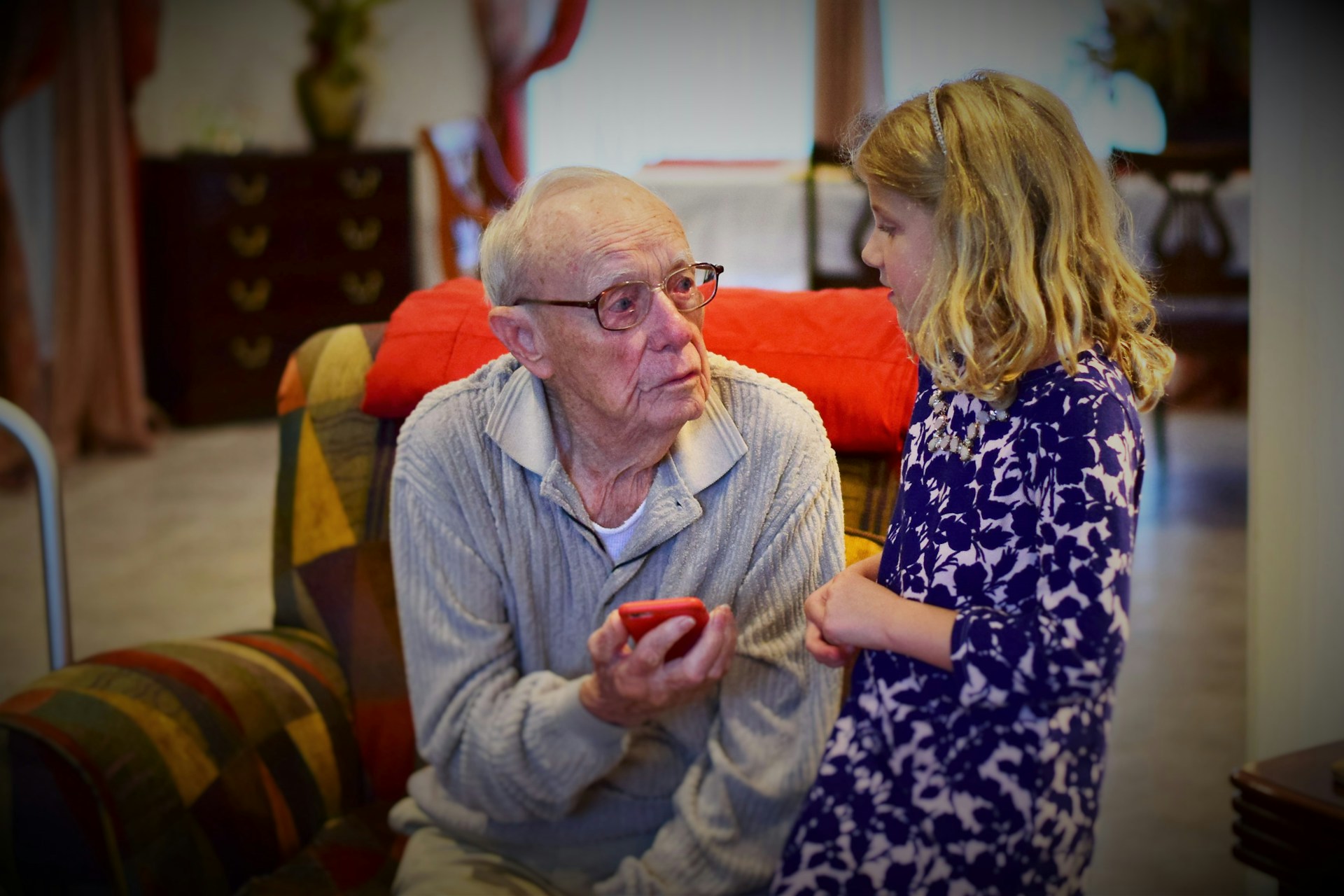
Perhaps, like John Lennox and Michele Guinness, you are aware of your old age and grey hairs. If this is you, who are you sharing your stories with in the younger generation? Who might want to hear of how God has been faithful in your life?
Or perhaps you are in your youth, with your life stretched out ahead of you. If this is you, which older people do you have in your life? Which of them might want to tell you their stories of God’s goodness?
Or maybe, like me, it’s fairer to say you’re somewhere in the middle of life. If this is you, who have you received stories from, and who will you be passing them onto? How are you acting as an inter-generational conduit for the Christian faith in your context?
As ever, constructive comments are welcome below.
(Please note: This is my ‘thought for the month’ reflection for June. You can find all my ‘thought for the month’ reflections here.)

6 Comments
It’s all about witnessing. That was Jesus’s commission to his disciples, God’s strategy for the expansion of His kingdom. The Bible is His, and our, testimony, of all the things He has done and mans response. A record of who God is and how powerful He is. Do we read it with awe and wonder, or just as a good book? Do we expect the level of miracles displayed in every part, or have we watered them down, shrinking God down to an understandable, humanly logical place?
Our stories are then an extension to His eternal plan. We can encourage others with what God has done in our lives, showing the continuation of the kingdom.
Thank you for sharing your testimony every month. It’s such and encouragement, and allows perception of God to grow and expand towards who He is, and not be put into a box.
Thanks for taking the time to comment, Elizabeth. I like your thought that our stories are an extension of God’s eternal plan. They are definitely part of it, if he is central to them – and, like you say, that’s when they can bring so much encouragement to those with whom we share them!
Am definitely feeling in the old and grey bracket! I love Psalm 71 and read it myself recently. Yes, we are called to chat about what God means to us and what He has done, to share our experiences of Him. It is about looking for, and embracing those opportunities, especially with the younger generations.
Thanks for these thoughts, Joy. Here’s to looking for, and embracing, opportunities to share our ‘God stories’ with the younger generations!
Thank you for sharing your experiences of healing from the Lord Jesus. My family need healing, as one child has severe epilepsy following premature birth and brain haemorrhage, and another with cancer of her scalp. Please pray for healing for my family as I believe that Jesus heals today as He did when he walked the earth. Thank you. Jolly
Thank you for sharing these prayer requests, Jolly. I will pray that you can hear what the Lord is saying about your children, so that you can stand firm on his word for them – because, as you say, Jesus still heals today.